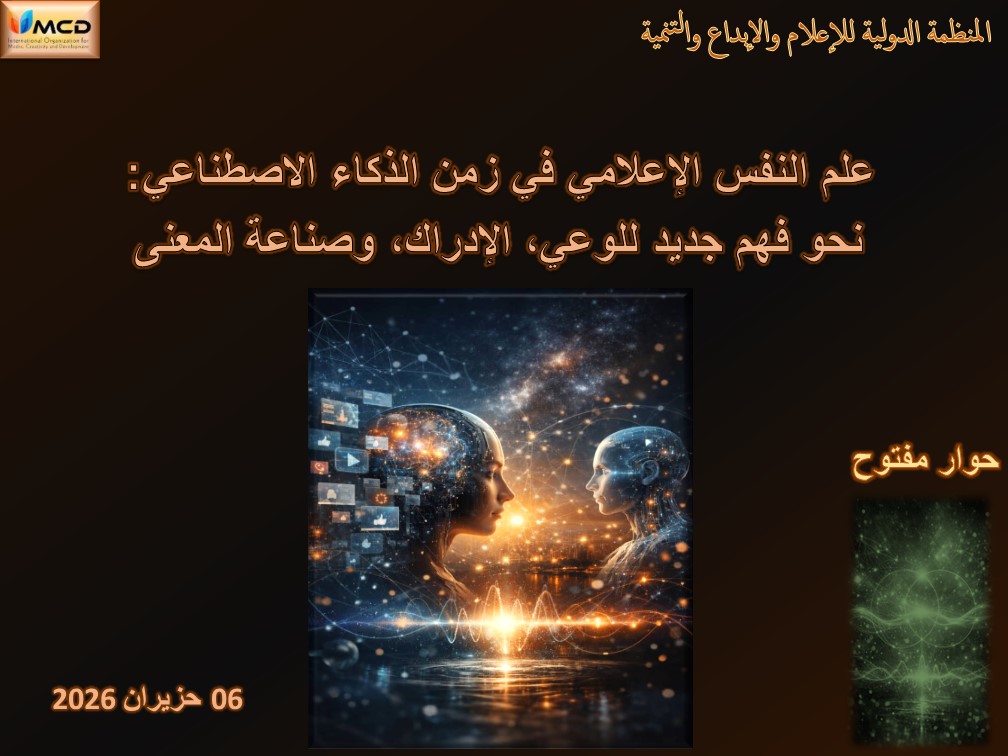
2026-06-08
On June 6, 2026, the International Organization for Media, Creativity & Development held an open dialogue on its digital platform, bringing together numerous academics and specialists from various fields to exchange their perspectives and expertise on Media Psychology in the Age of Artificial Intelligence.
The session was moderated by the organization’s president, Dr. Madeleine Kassab, who emphasized the importance of acknowledging the profound transformation in the nature of the relationship between humans and communication systems. Media is not merely a process of transmitting information or influencing public opinion; rather—especially in the current era—it constitutes a complete psycho‑cognitive environment that shapes the factors involved in forming awareness and personality through: the engineering of attention and memory, the construction of individual and collective identity, the steering of imagination toward horizons that serve known or unknown actors, and the fulfillment of certain needs while generating new ones.
The entry of artificial intelligence into this environment has shifted the human role from interacting with content to becoming immersed in an intelligent algorithmic system that learns and teaches, predicts, and reshapes cognitive and psychological experience in real time. This shift urges specialists to move from asking: How does media affect humans? to: How is the human being psychologically and cognitively reshaped within intelligent media galaxies?
According to Dr. Kassab, media psychology in the age of artificial intelligence is not merely a research field—it is a necessity for understanding the human being who is now formed within digital technological spaces.
Key points discussed in the dialogue:
1- The main areas of focus in media psychology:
- Studying the impact of content on behavior.
- Examining mechanisms of perception and interaction by exploring how the human brain processes written, auditory, and visual information that shapes values and ideas.
- Studying “uses and gratifications” theories and analyzing why audiences adopt and select certain media channels and content to satisfy their needs.
- Investigating the relationship between technical design and human behavior by analyzing psychological interaction with user interfaces and the design of intelligent applications.
2- Some objectives of media psychology and its societal role:
- Improving media discourse and guiding institutions and specialized entities to create purposeful content that promotes intellectual and psychological development and meets the educational needs of society.
- Raising awareness by helping individuals use communication tools in healthy ways and engage consciously with the form and substance of modern media and technological messages.
3- Essential considerations for media psychology in the age of artificial intelligence:
- The transformation of the recipient into a “cognitive node.”
In traditional models, the individual is viewed as a receiver of messages. Today, the individual has become a node within a network—a source of massive data and a generator of meaning. Algorithms predict behavior and reshape cognitive experience before the individual becomes aware of it. Thus emerges the algorithmically reshaped self, interacting with content that changes according to its precise preferences. This marks a shift from the receiving human to the probabilistic human—a human whose cognitive experience is constructed through a chain of algorithmic predictions that precede awareness.
- The transformation of attention engineering.
Artificial intelligence does not merely capture attention; it measures it in real time, predicts it, redirects it, and constructs a cognitive environment resembling a “probabilistic bubble” beyond which the individual cannot see. Thus, engineered attention—as described by Dr. Madeleine Kassab—does not stem solely from individual choice but from algorithmic design that precisely identifies psychological vulnerabilities.
- Memory in the age of AI: the “replaced memory”.
Human memory is naturally selective and reconstructive. But in the digital environment, a replaced memory emerges: the past is rewritten through recommended content, personal experiences are substituted with ready-made narratives, and facts become probabilities that shift with every interaction. This creates cognitive fragility that leaves individuals vulnerable to misinformation—consciously or unconsciously.
- The new propaganda.
According to Dr. Madeleine Kassab, modern—or algorithmic—propaganda does not rely solely on direct messaging but on: algorithmic repetition, hyper‑personalization, manufacturing false consensus, attention engineering, information overload, and the creation of closed cognitive environments. These features have shifted propaganda from persuasion to reality‑shaping: “It is propaganda that does not persuade but surrounds; it does not argue but overwhelms, crafting a world that appears more natural than truth itself.”
- The psychology of emotion in the digital sphere.
Emotion is no longer merely an internal experience; it has become measured, predicted, targeted, and reproduced based on precisely studied variables. Digital platforms know when users feel anger, motivation, comfort, loneliness, and other emotional states. They also know when individuals are most susceptible to influence and use this knowledge to guide behavior through algorithmic emotional regulation.
Consequently, digital belonging becomes part of the individual’s psychological structure: digital identity is shaped through the platform, the audience, the algorithm, interaction patterns, and digital social expectations. Thus emerges a self that shifts with the digital context and redefines itself according to the reward systems imposed by the digital environment.
- Artificial intelligence as a psychological actor.
AI is no longer a tool but a psychological partner, an emotional consultant, a meaning engineer, and part of the human cognitive structure. Its capabilities allow it to enter domains once exclusive to human relationships—such as reassurance, emotional disclosure, self‑exploration, and decision‑making that accounts for internal and external factors surrounding the individual. Thus, AI has become part of the user’s psychological architecture.
- The psychology of algorithms.
According to Dr. Madeleine Kassab, the psychology of algorithms and the way “the machine thinks” about humans must be studied alongside the psychology of contemporary humans. Algorithms do not perceive humans as selves but as patterns, probabilities, decision chains, and clusters of data points. This creates a new psychological gap: humans see themselves as selves, while the machine sees them as probabilities. This affects self‑esteem, identity, the sense of freedom, and the meaning of choice
- The new semiotics.
Artificial intelligence has transformed the mechanisms of producing, generating, and transmitting signs. In traditional media, a sign consisted of the signifier, the signified, the context, the sender, and the receiver. In the digital age, the algorithm becomes a semiotic mediator: it does not merely transmit the sign but rearranges, interprets, and redirects it, linking it to other signs according to its own logic. Thus, algorithmic semiotics emerge, where meaning is generated through the interaction of multiple variables, including: the human, the content, the social network, the algorithm, and the explicit and implicit goals of the propagandist.