2026-06-21
IOMCD
In recent years, so‑called “AI detection tools” have become widely used, commonly perceived as systems capable of distinguishing between human‑written texts and those generated by large language models. This text aims to analyze the current state of these tools, deconstruct their technical foundations, and assess their methodological limitations, in addition to discussing their ethical, political, and epistemic implications. The findings show that AI detectors suffer from high error rates, linguistic and cultural biases, and the absence of a scientific standard for defining “human text,” making their use in academic or institutional contexts highly risky. The text proposes shifting from a logic of “detection” to a logic of “transparency” by adopting new evaluation models that focus on ideas and context rather than statistical fingerprints.
1. Introduction
The rapid development of generative language models has led to the emergence of new tools known as AI detectors—systems designed to determine whether a text was written by a human or a machine. Despite their widespread adoption in educational and media institutions, their scientific reliability remains highly contested.
This study seeks to provide a critical analysis of these tools through a multi‑layered approach encompassing technical, ethical, political, and epistemic dimensions.
2. The Technical Foundations of AI Detectors
Detectors rely on a set of statistical indicators, most notably:
- Randomness metrics: assuming that human texts are more diverse and less predictable.
- Linguistic coherence analysis: machine‑generated texts are often more uniform.
- Repetition tracking: generative models tend to reuse certain structures.
- Comparison with known linguistic fingerprints of common models.
However, these foundations face fundamental challenges, the most important of which is that language models learn from humans; thus, their “fingerprints” gradually converge, making the distinction increasingly difficult.
3. Accuracy and Methodological Limitations
Recent studies indicate that detector accuracy ranges between 35% and 65%, a rate insufficient for making decisive judgments. This limitation stems from several factors, including:
- The ease of bypassing detectors through paraphrasing or adding linguistic noise.
- Linguistic biases that classify non-English writing as “machine‑generated.”
- The absence of a unified definition of human text, rendering the distinction largely speculative.
- The rapid evolution of generative models compared to the slower development of detectors.
These findings confirm that detectors do not reveal “the author,” but rather their own preconceived expectations of what human writing should look like.
4. Ethical Dimensions
AI Detectors raise serious ethical concerns, including:
- Accusing students or researchers of cheating without conclusive evidence.
- Excluding linguistic and cultural groups due to stylistic differences.
- Creating an atmosphere of suspicion around any coherent or high‑quality text.
- Lack of transparency in decision‑making processes.
Granting an algorithm the authority to judge the “authenticity” of a text creates an imbalanced relationship between humans and technology, turning the detector into an unaccountable surveillance tool.
5. Political and Institutional Dimensions
Multiple interests drive the spread of AI detectors, including:
- Educational institutions seeking quick solutions to control cheating.
- Companies leveraging fear of AI to market their products.
- Governments concerned about misinformation.
- Media platforms aiming to protect “content authenticity.”
However, these interests may lead to linguistic surveillance, the criminalization of writing, restrictions on freedom of expression, and institutional discrimination against certain groups. Thus, “detection” becomes as much a political practice as it is a technical one.
6. The Epistemic and Philosophical Dimension: What Does It Mean for a Text to Be Human?
Detectors confront us with a fundamental question: Is “humanness” in a text a matter of style, intention, experience, or consciousness?
A human text is:
- A trace of memory
-An emotion embodied in language
- A cultural context
- A relationship between writer and reader
- A mark of the self, even when neutral.
Whereas a machine‑generated text is:
- A statistical simulation
- A recomposition of language
- A response to a pattern
- An algorithm learning from millions of humans.
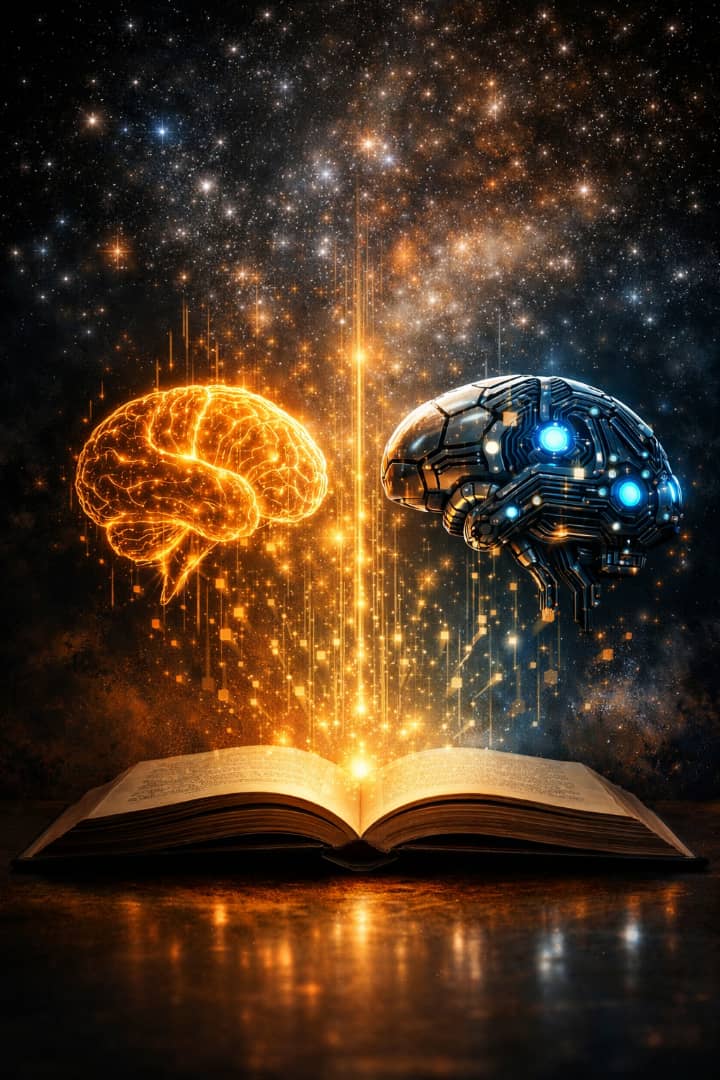
But the boundaries between them have become blurred: humans use AI, and AI learns from humans. Traditional criteria can no longer separate the two.
7. The Metaphysics of Text in the Age of Algorithms
Perhaps the deeper question is not: “Was this text written by a human or a machine?” but rather: “What makes a text alive?”
A living text is one that opens a horizon, raises a question, transforms its reader, leaves a trace, and creates a relationship. These qualities are not exclusive to humans or machines, but to meaning itself. A human may write a dead text, and a machine may produce a text that awakens an idea or a feeling. Thus, the criterion is no longer “the author,” but “the effect.”
8. Toward an Alternative Model: From Detection to Transparency
This text proposes shifting from a logic of “detection” to a logic of “transparency” through:
- Encouraging voluntary disclosure of AI use.
- Developing evaluation standards focused on ideas and analysis rather than linguistic fingerprints.
- Strengthening critical thinking skills among students and researchers.
- Using tools that verify sources rather than tools that verify authorship.
- Embracing the concept of “collaborative writing” between humans and machines.
Through this shift, AI becomes part of the creative process rather than a threat to it.
Conclusion
This study reveals that AI detectors are not neutral technical tools but systems embedded with epistemic, ethical, and political assumptions. They mirror our fears of losing control, our anxiety over the fading boundaries between human and machine, our desire to protect “authenticity,” the fragility of our writing standards, and the transformation of text from a fixed entity into a shared space.
Relying on them uncritically may lead to academic injustice, linguistic discrimination, and restrictions on freedom of expression. Accordingly, this research calls for rethinking our relationship with text and writing, shifting from an obsession with “detection” toward building a transparent, fair, and collaborative writing environment—one that recognizes that creativity in the age of algorithms emerges from continuous interaction between humans and machines, between biological and artificial minds.