2026-10-31
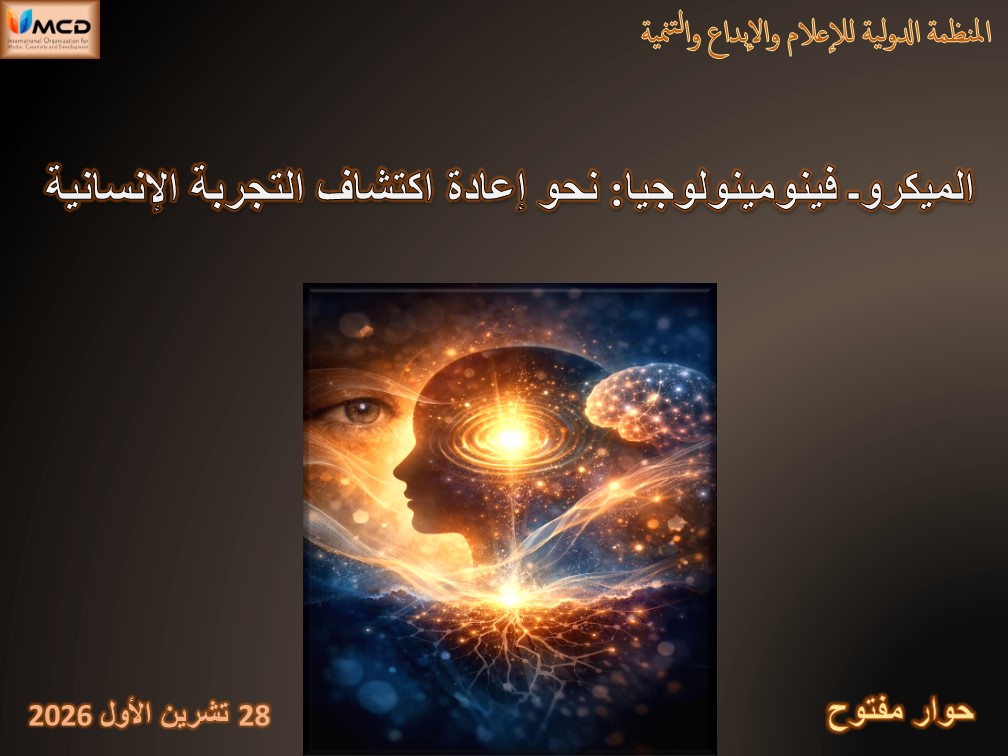
On October 28, 2026, the International Organization for Media, Creativity, and Development hosted an open dialogue via its online platform. The event brought together numerous academics and specialists from various fields who exchanged perspectives and expertise on micro-phenomenology as a contemporary research methodology. This approach reopens the file of precise human experience, providing cognitive and media sciences with novel tools to understand consciousness in its most concealed moments. The session was moderated by Dr. Madeleine Kassab, President of the Organization.
The dialogue addressed several key themes:
1- Defining Micro-Phenomenology: Toward a Precise Understanding of the Structure of Human Experience
Micro-phenomenology serves as a "psychological microscope" that explores the minute dimensions of living human experience—dimensions that are fleeting or semi-conscious and typically overlooked by the individual. It delves into the infinitesimal details of a moment (lasting a single second or a fraction of a second) to retrieve the precise structure of what occurs within an experience before it is mentally reinterpreted or reformulated.
This definition positions micro-phenomenology in a unique place among scientific methodologies, granting researchers the capacity to transform minute inner impressions into studyable data, and opening the door to a fresh understanding of the relationship between consciousness, attention, and inner time.
2- Methodology: How Does Micro-Phenomenology Work?
The methodology relies fundamentally on elicitation interviews, which involve three core steps:
- Fixating the lived moment: Evoking a precise event, such as the moment of making a quick decision or the birth of a creative idea.
- Slowing down inner time: Replaying the tape of the experience in extreme slow motion to reveal minute details that usually go unnoticed.
- Deconstructing consciousness: Focusing on how the experience emerges rather than merely on causality; that is, tracking mental images, bodily shifts, and directions of attention.
This methodology grants researchers an unprecedented ability to capture the precise structure of consciousness, allowing for the analysis of experience before it undergoes interpretation or hermeneutic framing.
3- Scientific and Cognitive Applications: Bridging Subjective Experience with Neural Data
The dialogue discussed the broad scientific applications of micro-phenomenology, particularly in cognitive science and neuroscience. It is used to link participants' precise self-reports with fMRI and EEG data, thereby enabling a deeper understanding of the relationship between neural activity and the micro-structure of consciousness. Speakers also highlighted the role of this method in studying:
- Chronic pain: Analyzing the temporal structure of the sensation of pain moment by moment.
- Complex problem-solving: Tracking minute mental operations during thought processes.
- Artistic creativity: Understanding how a creative idea is generated before transforming into a tangible work.
In this sense, micro-phenomenology acts as a bridge between quantitative and qualitative data, offering cognitive sciences a new language to understand human experience.
4- Psychological and Clinical Dimension: Enhancing Self-Awareness and Reconstructing Experience
The dialogue addressed the therapeutic role of this method, particularly in mindfulness-based psychotherapy. The ability to describe the minute details of inner experience helps patients understand how emotions—such as anxiety or fear—form moment by moment. A patient can precisely describe: Where did the physical tension begin? How did breathing change? What mental image appeared? How did attention shift? These details grant the therapist a deeper understanding of the hidden mechanisms behind emotion, paving the way for more precise therapeutic interventions.
5- Spiritual and Metaphysical Dimension: A New Language for Understanding Inner Disclosure
The dialogue highlighted micro-phenomenology's capacity to approach spiritual experiences, which for a long time were deemed indescribable and beyond precise analysis.
In studying meditation or moments of spiritual opening, this method can reveal: the expansion of the perceptual field, altered senses of time, the dissolution of boundaries between the inner and outer self, and the emergence of a sense of harmony or unity. These details provide spiritual studies with a precise scientific language, redefining the spiritual experience as a phenomenon open to analysis without losing its symbolic depth.
Furthermore, this method opens the door to comparisons between different spiritual traditions. Spiritual disclosure in Islamic Sufism, described as "fath" (opening/illumination), can be compared to disclosure in Buddhism, described as "enlightenment", or in Christianity, described as "grace". Through micro-phenomenology, the precise structure of these experiences can be studied, uncovering points of similarity and difference, thus enabling a new understanding of spirituality as a universal human phenomenon.
The dialogue also explored the relationship between this methodology and metaphysical questions: What is the nature of consciousness? Is a spiritual experience a psychological event or an existential one? How do the individual and the cosmic intersect in the moment of disclosure?
6- Methodological Challenges: The Limits of Description and Precision
Prominent among these challenges are:
- The possibility that descriptions are retrospective reconstructions of the experience.
- The influence of researcher expectations or interview questions on the participant's description.
- The need for intensive training in non-directive listening.
- The philosophical question: Can precise language encompass the infinite?
These challenges reveal the complex nature of micro-phenomenology and the ongoing need to develop more rigorous tools to ensure descriptive accuracy.
7- Conclusion: Micro-phenomenology as a Bridge Between Science and Spirituality
The dialogue concluded by emphasizing that micro-phenomenology represents a silent revolution in the study of human experience. It combines scientific rigor, philosophical depth, spiritual sensitivity, and methodological precision, offering cognitive science, psychology, and spirituality a new language for understanding inner experience in its most intimate moments.