2026-05-15
IOMCD
The attention economy is an economy that does not sell products—it sells awareness itself. This economy has transformed attention from a human capacity governed by traits and variables into a commodity, perhaps even the most valuable commodity in the global market. Notifications now accelerate faster than deep thoughts, and the question shifts from “What do we want to know?” to “Who wants us to know what?”
* Attention as a New Currency
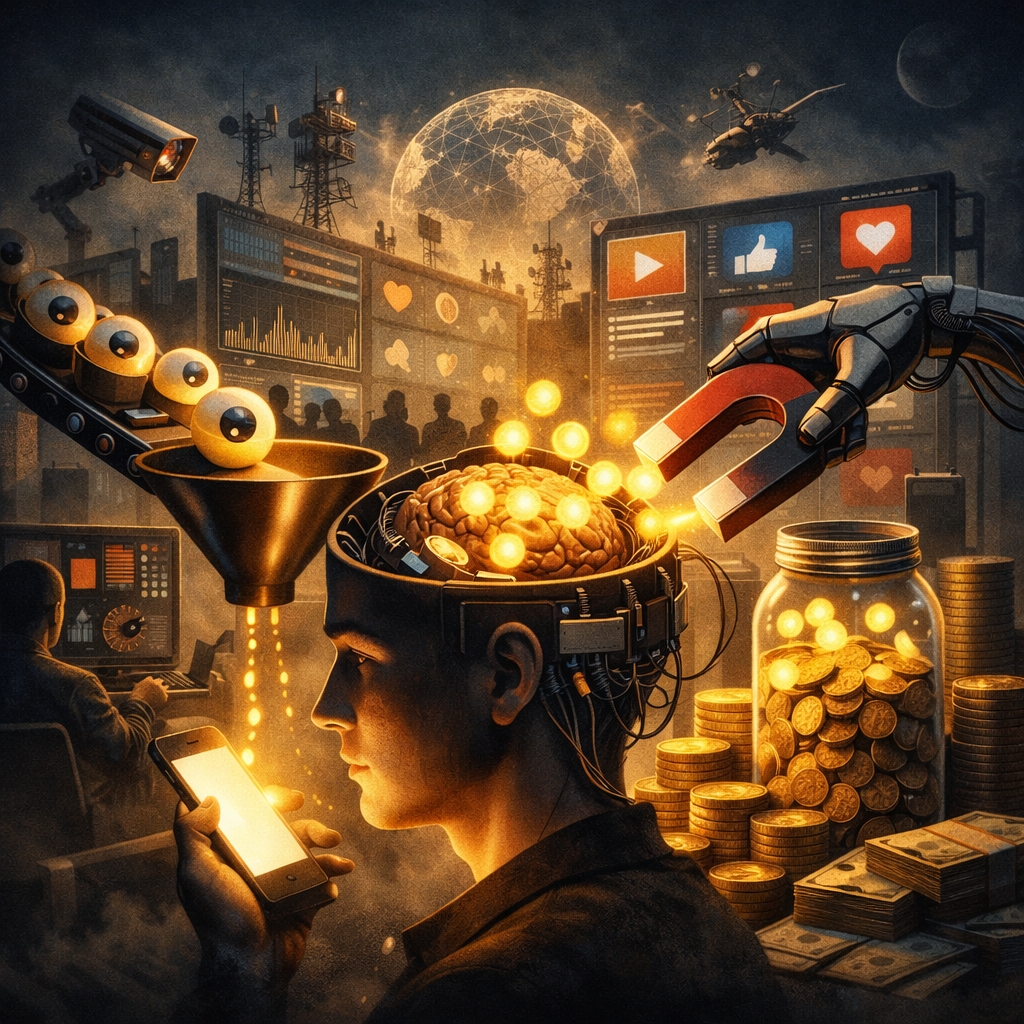
In the traditional economy, a person receives goods that meet their needs in exchange for paying money. In the attention economy, however, the price is far higher: individuals pay with their time, focus, emotions, and other cognitive energies—consciously or unconsciously. The time a person spends on their screen is converted into financial value for entities they may not even know. In other words, individuals hand over their energy and the essence of their attention to beneficiaries whose identities are invisible to them.
Digital platforms do not always compete on content quality, but rather on their skill in attracting the user and keeping them confined as long as possible within the bars of cognitive and psychological temptation. Every additional minute means more profit through ads and data.
* The Merchants of Attention
The players in this market are many, and each party purchases attention for different purposes. The merchants of the attention economy operate within a full system that includes technology companies, advertisers, data‑analytics firms, political and religious parties, financial institutions, security agencies, and more. Their goals range from selling products, shaping public opinion, controlling attention and guiding behavior, to collecting massive amounts of data that serve as the foundation for prediction and influence.
Thus, day after day, attention becomes a strategic resource whose power rivals that of oil in the twentieth century.
* Engineering Awareness Through Attention Control
One of the main goals of the attention economy is to turn the human being into a constantly stimulated creature, preoccupied with following content presented to them based on precise algorithmic calculations that not only attract the eye but reshape the brain’s entire mode of operation. Algorithms are designed to identify each individual’s sources of intellectual and emotional stimulation, as well as the roots of fear, anger, and other triggers and impulses. This enables them to reorder content so that the individual remains in the consumption loop for as long as possible.
* The Attention Economy Controls Behavior
Whoever controls attention controls the thoughts, fears, desires, and inclinations of targeted individuals—and this control leads to control over the behaviors that arise from all these variables. Thus, the attention economy can also be described as a behavior economy.
All displayed data aims to provoke a response, especially through emotional manipulation. It is designed to push the individual toward a predetermined decision. This engineering process is executed with extreme precision, relying on seduction rather than force, so that a person feels that any thought or behavior originates from within, not imposed by an external actor.
* Resisting the Attention Economy
This resistance is tied to personal sovereignty. It is not merely a technical issue but a real struggle between the human being and an informational‑media environment designed for total control over awareness. Withdrawing from the digital world is not a solution, because resistance lies in understanding the mechanisms of influence and cognitive manipulation, strengthening critical‑thinking skills, and developing media and technological policies that protect users from falling into the trap of epistemic deception.
Thus, attention is not merely a cognitive ability—it is the first and most dangerous stage in the formation of human awareness and behavior.