2026-06-09
IOMCD
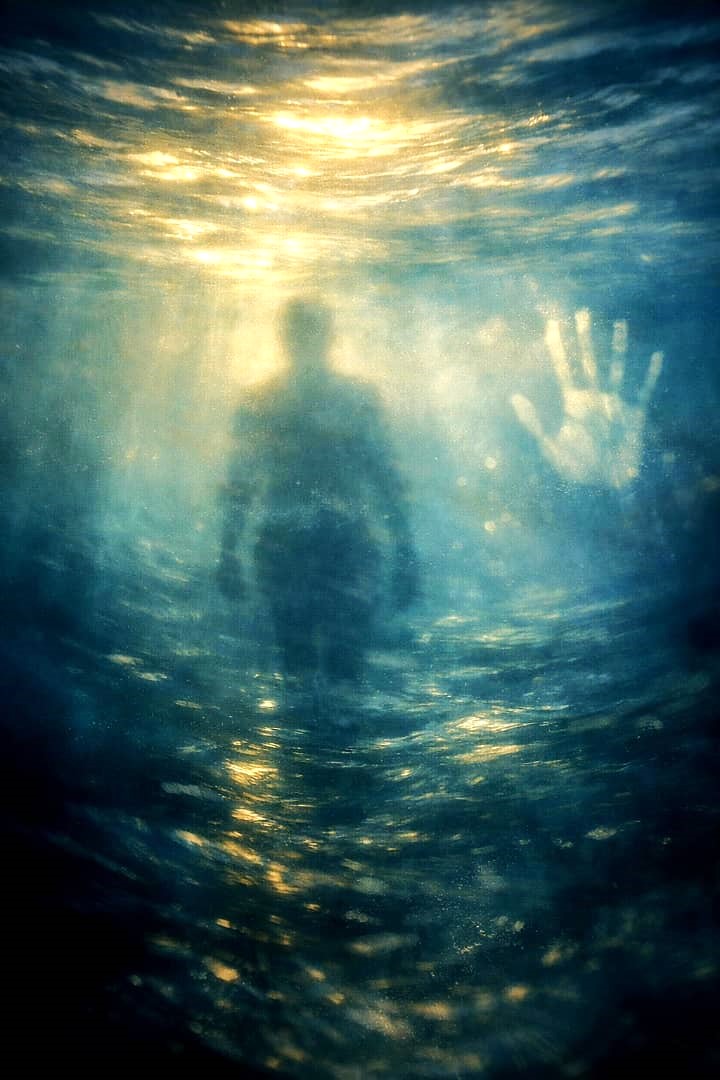
For thousands of years, humanity has engaged with water as both an element and a symbol of life—a medium of purification and a bridge between worlds. Yet what has rarely been discussed is the idea that water is not merely matter, but memory. A memory not inscribed in letters, but in vibrations, in traces, in the movements, sounds, and touches left by human presence. In its essence, water is not as still as it appears; it is a being that remembers. This notion is gaining ground in scientific and philosophical discussions exploring water’s capacity to retain imprints, record interactions, and transform them into an invisible narrative expressing the human relationship with the world.
Although this concept has not yet been firmly established within experimental science, certain contemporary theories in biophysics reveal that water molecules can reorganize themselves in response to external influences—sound, heat, movement, subtle charges produced by contact, or even human intention. This opens a rich epistemological horizon and a vast philosophical gateway for understanding water as a living medium rather than inert matter, as a carrier of traces that may be considered a form of invisible storytelling. Such thinking does not imply a mystical interpretation; rather, it is an attempt to read the dynamics of matter from a perspective that transcends the boundaries of classical physics.
When we wash our hands, immerse our faces in a river, or leave footprints on a shore, we leave a trace—often invisible. Yet water captures movement, reconfigures and redistributes it, then carries it along its long journey across the earth. It is as though water were an energetic tablet beyond space, preserving secrets as a flowing, mutable memory.
From an anthropological perspective, water has always played a central role in rituals and worship. In ancient cultures, it was treated as a witness—an element capable of carrying intention, purifying memory, and transmitting messages between realms. These symbolic conceptions reveal an early and profound awareness that water is not neutral; it is a mediator between beings and the world, interacting with humans, influencing them, and being influenced in return. If ancient civilizations regarded water as a witness to ritual, modern science extends this view, recognizing water as an environmental archive that holds traces of human activity—from micro-pollutants to the chemical fingerprint of entire societies.
On the ecological level, aqueous memory acquires a different and crucial meaning. The waters that flow through cities, rivers, and oceans carry with them an unwritten history of civilization: industrial residues, consumer waste, chemical substances, and even microscopic particles born of daily life. Thus, water becomes a living archive, recording what we do and redistributing it spatially and temporally through an endless cosmic cycle. Understanding this dimension transforms water from a mere resource into a being of influence and resonance, linking humanity and the environment in a complex reciprocal relationship.
From the standpoint of environmental psychology, the human relationship with water transcends function and enters the realm of perception. Bodies of water are among the most powerful elements for calming the nervous system and restoring internal rhythm. Numerous studies show that simply gazing at water—even in still images—activates brain regions associated with emotional stability.
Psychologically, water can be seen as a mirror of the inner self. When a person stands before a water surface, they do not merely see their reflection—they see beyond it: their agitation when the water trembles, their serenity when the surface stills, their fragmentation when reflections break apart. Thus, water reflects not only the face but the entire state of being. This interaction suggests that water not only stores human traces but also influences the psyche itself—it is the medium that mirrors and reshapes the inner condition.
The concept of aqueous memory also offers a new model for understanding the relationship between matter and consciousness. This memory cannot be possessed, confined, or frozen into a single form or structure. Through its continuous cycle of evaporation, condensation, and flow, water resembles human consciousness in its mutable nature. It is a memory that never settles but renews itself—evaporating, returning as rain, and beginning again. This makes it a powerful metaphor for human memory itself: a memory not contained in one place, but moving through time, constantly reshaping its own form.
Ultimately, this vision of water reconfigures our thinking and restructures our relationship with the elements that surround us. Water is a partner in existence and awareness, not merely a resource. Through it, the human trace becomes part of a greater cosmic narrative, reminding us that every movement, every touch, every act—no matter how small—leaves an imprint upon the world as a whole.